
Egg Carton Labels - What do the dates and numbers mean?
Have you ever wondered what the small printed dates and numbers on each egg carton mean? Of course, most people examine the carton for broken or cracked eggs inside and check the "sell-by" date to get the freshed carton on the shelf, but what does it really mean?
Here are the explanations!

Sell-by Date:
The date may not exceed 30 days from the date on which the eggs were packed (excluding the day of pack) . The egg shell protects the eggs very well and unnwashed eggs, if refrigerated at 40 to 45 F, would keep for a very long time. However, federal regulations require commercial egg producers to wash the eggs, due to the potential for external contamination by salmonella and other pathogens. This means the shelf-life of the eggs starts degrading.
Egg processors typically print dates commonly called "Code Dates" on cartons. sometimes they say "EXP," "Sell By," and "Best if Used Before". The use of code dates on USDA graded eggs is optional; it is NOT required by federal law. some states, like California DO require them. Anywhere if they are used, certain rules must be followed:
- If an expiration date is used, it must be printed in month/day format and preceded by the appropriate prefix.
- Expiration dates can be no more than 30 days from the day the eggs were packed into the carton.
Another type of code dating used indicates the recommended maximum length of time that the consumer can expect eggs to maintain their quality when stored under ideal conditions. Terminology such as "Use by", "Use before", "Best before" indicates a period that the eggs should be consumed before overall quality diminishes. Code dating using these terms may not exceed 45 days including the day the eggs were packed into the carton.
Julian Date of Pack:
The consecutive date of the year on which the eggs were packed. . Example: The Julian date for January 1 is 001, the Julian date for December 31 is 365.
Plant Identification Number
This is the Egg Handlers Registration number; it indentifies where the eggs came from, to trace them back to their origion in the event of food poisoning.
Egg Grades
Egg Grading refers to both the exterior and interior of the egg. The eggs must be clean and free of major defects on the outside as well as the inside. ALL eggs are supposed to be candled to identify any internal defects. Refer to the USDA Egg Grades & Standards and the USDA Egg Grading Manual for complete instructions.The grade of a shell egg is determined by the size of the internal air-cell. As an egg ages, the liquid contents evaporate through its pores. The larger the air-cell is, the lower the grade of the egg. The outside appearance also factors into the grade of an egg. Eggs with moderate staining (but not adhering dirt) can be sold as grade "B." All other grades require a clean, unblemished shell appearance. Dirty eggs cannot be sold to consumers. The size of an egg is determined by its weight, in grams. A small egg must weight 40.16 grams or more, a jumbo egg must weigh 68.51 grams or more.
- Grade AA: These eggs have the thickest whites. The shell must be clean and unbroken. The air cell is limited to 1/8 inch depth at original and 3/16 inch at destination. The white must be clear and the yolk practically free of apparent defects.Considered a desirable quality in cooking because they do not spread easily, making them excellent for frying. The yolks are high, round and defect-free. U.S. grade AA egg shells are unbroken.
- Grade A - The shell must be clean and unbroken. The air cell is limited to 3/16 inch depth at original and 1/4 inch at destination. The white must be clear and the yolk practically free of apparent defects.Grade A eggs also have thick whites, just slightly thinner than Grade AA.
- Grade B - The shell must be clean and unbroken and may have unlimited slight stains (but not dirt clinging to shell). The air cell may not exceed 3/8 inch. The white must be clear and the yolk practically free of apparent defects. The white may be weak and watery and the yolk outline plainly visible the yolk may appear dark, enlarged and flattened. It may show other serious defects which do not render the egg inedible.Grade B eggs usually have thinner egg whites, making them best for cake mixes and omelets.
The nutritional value and taste of all the grades is the same.
Egg sizes
Eggs also are sold in a bewildering variety of sizes, which are based on their weight, not volume. The size markings on egg cartons tell the minimum net weight for a dozen eggs. The size names and weight per egg is given below:
| Size or Weight Class |
Min Weight per Egg |
Size or Weight Class |
Min Weight |
|
| Jumbo | 2.42 ounces | Medium | 1.67 ounces | |
| Extra Large | 2.17 ounces | Small | 1.42 ounces | |
| Large | 1.92 ounces | Peewee | no min |
NOTE: If you are unsure of the size of your eggs, label them the smallest size. For example, if you have at least medium sized eggs, label the carton as Medium. It is acceptable to have larger sized eggs in the carton.
More information?
An egg industry website has more detailed information on the
follow topics: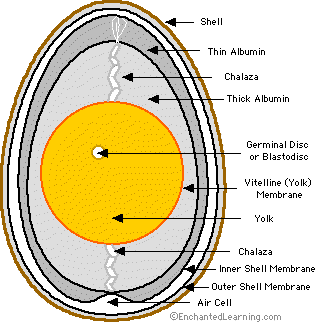
- Air Cell
- Blood Spots
- Breakout
- Buying
- Candling
- Egg Products
- Inspection Act
- Formation
- Haugh Unit
- Restricted Eggs
- Shell
- Yolk